
Settings
Every Settings page — General, Appearance, Lyric Highlight, Lyrics, Shortcuts, and one page per surface.
Settings is a sidebar and one page at a time. The top group is the app; the DISPLAY group below it is one page per surface.
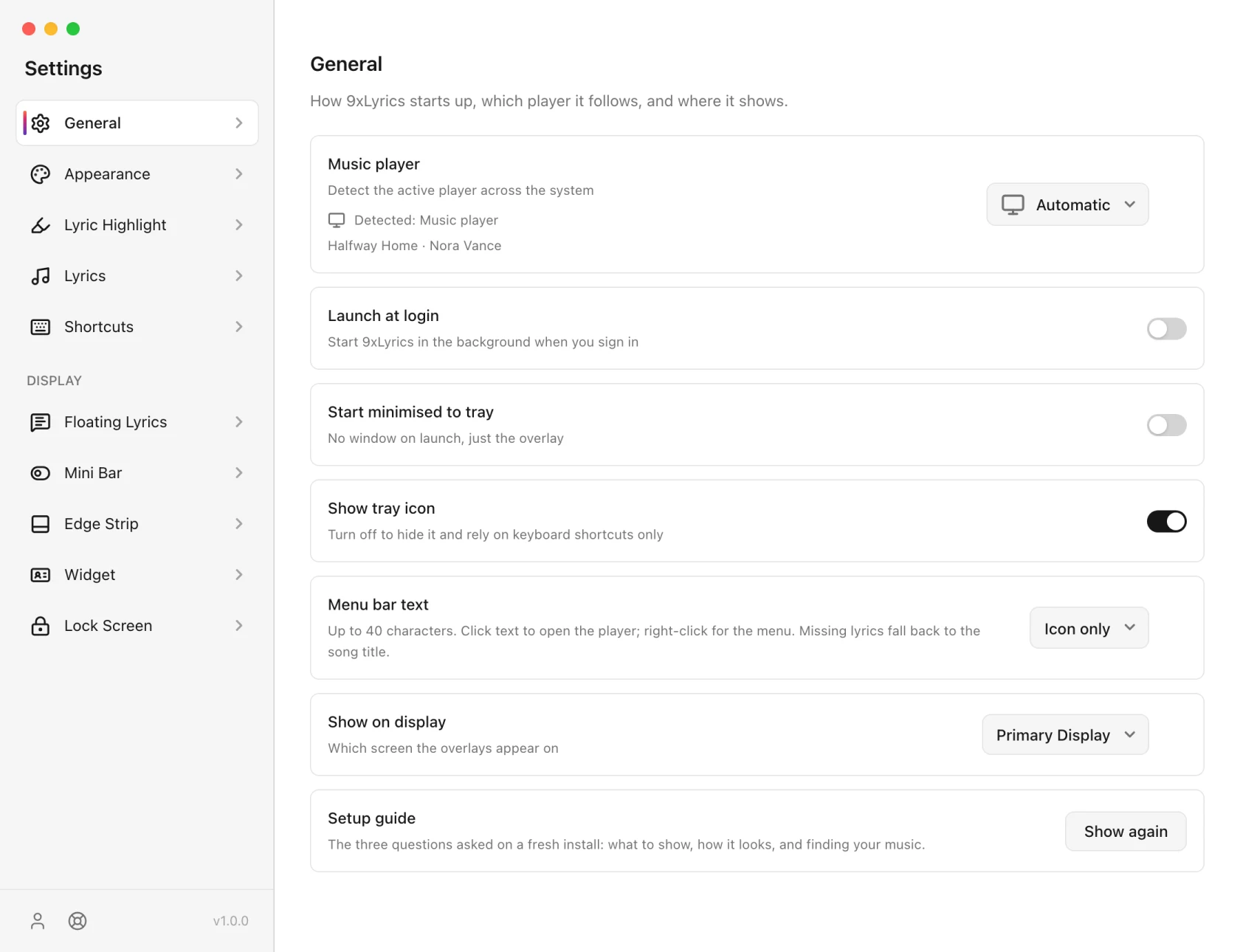
Pro controls stay visible on a free account rather than being hidden, so the setting a guide points at is where the guide says it is either way. Turning one on prompts to upgrade. Free and Pro lists what each plan unlocks.
General
How 9xLyrics starts up, which player it follows, and where it shows.
- Music player — Automatic follows whatever is playing. Pick a named player to pin it to one. The row underneath reports what is actually being detected right now, which is the fastest way to tell whether detection is working at all. See Players and detection.
- Launch at login starts 9xLyrics in the background when you sign in.
- Start minimised to tray — no window on launch, just the overlay.
- Show tray icon — off relies on keyboard shortcuts alone.
- Tray icon — Automatic picks what each system's tray expects: the logo in colour on Windows, the flat white mark on Linux and macOS. White, Black and Colour override it.
- Menu bar text (macOS, Pro) — Icon only, Song title or Current lyric in the menu bar, capped at 40 characters. Click the text to open the player; right-click for the menu. A song with no lyrics falls back to its title. Icon only is free.
- Show on display — which screen the overlays appear on.
- Setup guide › Show again replays the three first-run questions.
Appearance
How the settings and lyrics windows look, and what sits behind the words.
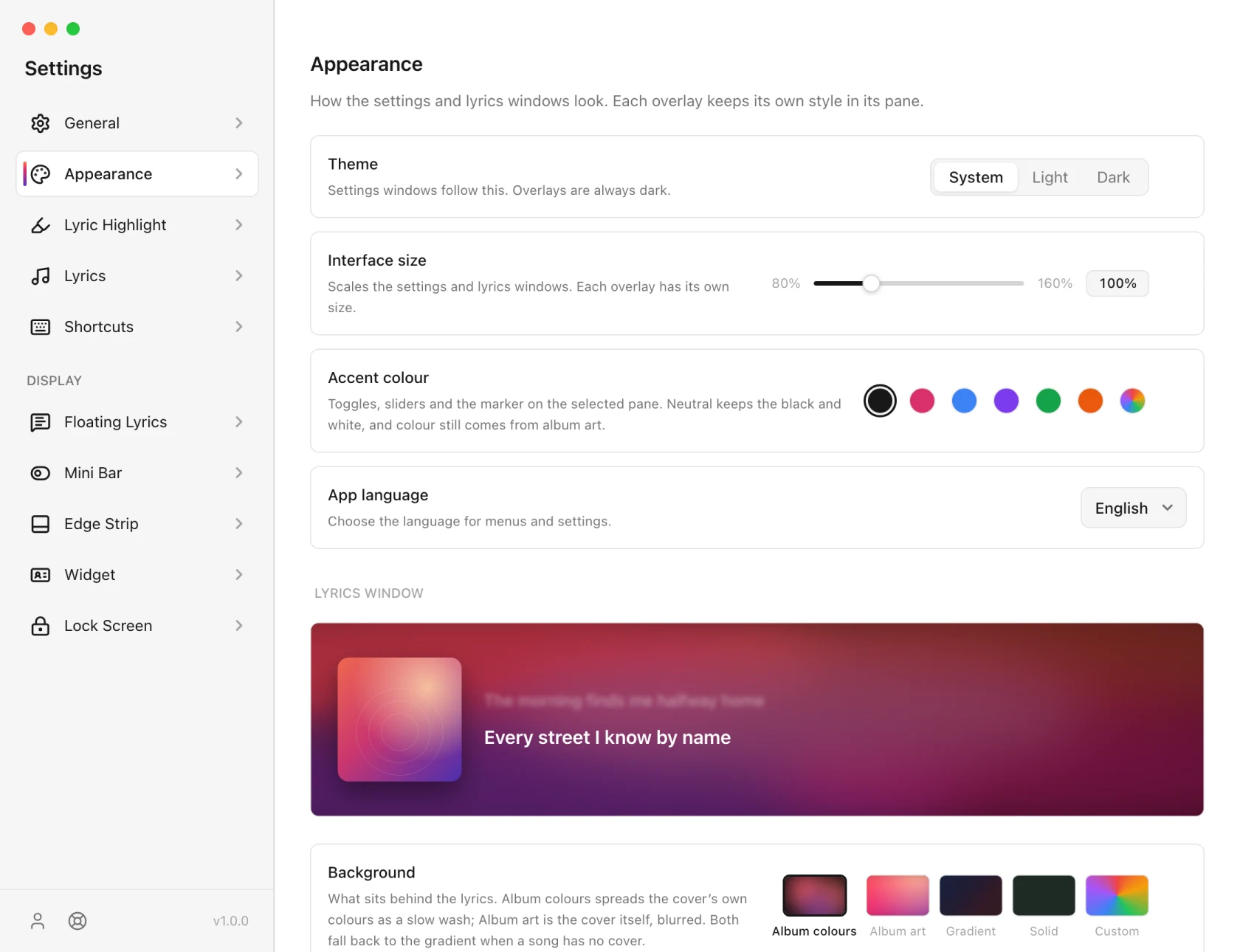
- Theme — System, Light or Dark. It applies to the settings and lyrics windows. The overlays are always dark.
- Interface size — 80% to 160%, scaling the settings and lyrics windows. Each overlay has its own size on its own page.
- Accent colour — the colour of toggles, sliders and the marker on the selected page. Neutral keeps the black-and-white scheme; colour still comes from album art either way.
- App language — nineteen languages.
- Background — what sits behind the lyrics. Album colours spreads the cover's own colours as a slow wash; Album art is the cover itself, blurred. Both fall back to the gradient when a song has no cover. Gradient offers five presets, and Solid and Custom are fixed colours. The art treatments and the gradients are Pro; a solid colour is free.
- Blur and Dim control how far the cover is pushed back so the words stay readable.
- Blur the other lines softens the lines away from the one playing, like a depth of field.
Lyric Highlight
The colours the current line is drawn in — shared by every surface, so they are set once. Covered in Karaoke and highlighting.
Lyrics
Where the words come from, and how they line up with the music.
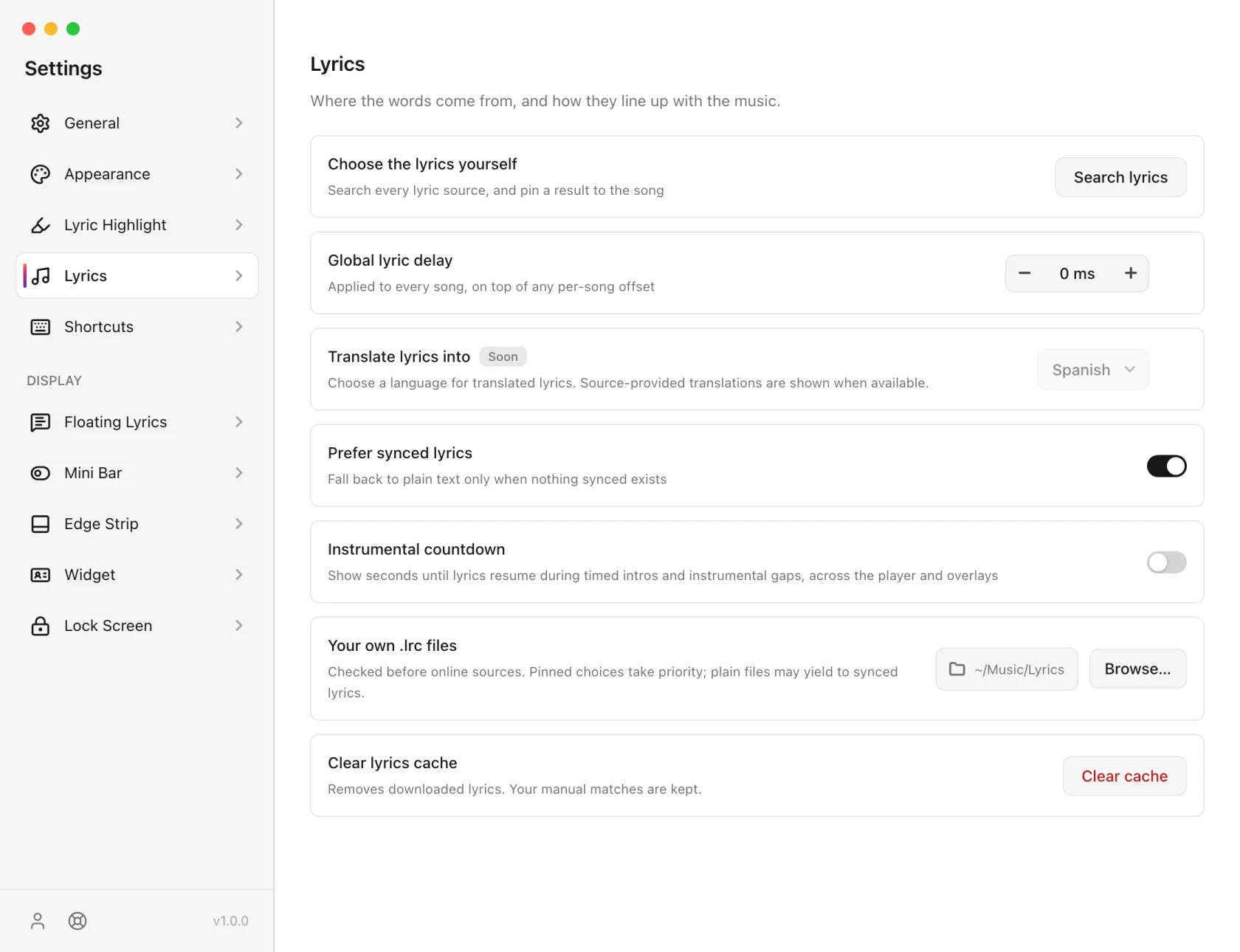
- Choose the lyrics yourself (Pro) — opens the search across every lyric source, and pins a result to the song. The same thing the Lyrics Window's Wrong lyrics? button opens.
- Global lyric delay — applied to every song, on top of any per-song offset. Use it when the whole system runs ahead or behind.
- Translate lyrics into — the language for translated lyrics, where the source provides them. Pro.
- Prefer synced lyrics — on by default; plain text is used only when nothing synced exists.
- Instrumental countdown — shows the seconds until the words come back during intros and instrumental gaps, across the player and the overlays. Off by default.
- Your own .lrc files — a folder checked before anything online. A file you have beats every source. Pinned choices still take priority; a plain text file may yield to a synced one.
- Clear lyrics cache — removes downloaded lyrics. Matches you chose yourself are kept.
Shortcuts
See Keyboard shortcuts.
The DISPLAY group
One page per surface, each with a live preview at the top drawn with your current song:
- Floating Lyrics
- Mini Bar
- Edge Strip
- Widget
- Lock Screen — macOS only
The sidebar footer
Two buttons at the bottom: your account, and support. The version number sits beside them, and turns into an update notice when there is one — see Updates.
Where settings are stored
Per machine. One account across two computers keeps two sets of settings, so a laptop and a desktop can show different things. Nothing about your settings leaves the machine.