
Features
What the 9xchat workspace can do, from agentic workflows to local models.
9xchat is built as a workspace rather than a chat box. This page walks through what that means in practice.
Each card below is one area of the desktop app.
Chats
- Threads, folders, and global search
- Switch model per message
- Context Shield to limit what is sent
- Multiple tabs in one threadPro
- Live web searchPro
Always-on windows
- Floating window kept on topPro
- Mini chat for quick questionsPro
- Quick assistant from a hotkeyPro
- Keyboard shortcuts and slash commands
- Smart screen capture
Local Models
- Connect Ollama models (Llama, DeepSeek, Qwen)
- Zero token fees and private local inference
- Local embeddings for Knowledge Base
Notes
- Notes and highlights beside your chats
- Save any reply straight into a note
- Export as text, PDF, Markdown, HTML, or JSON
Library
- Models, API keys, and local models
- Prompts library and agents
- Tools, skills, and MCP serversPro
- Knowledge collections
- Memories, with global, folder, and session scopePro
Mobile and Handoff
- iOS and Android apps with full cloud models
- Encrypted device-to-device chat handoff
- Voice dictation and read out loud on the go
Settings
- Appearance, language, and default models
- Embeddings, audio, and transcription providers
- Thread naming, archiving, and history
- Keyboard shortcuts, data, and exports
Working with models
Model agnostic
You are not locked into one ecosystem. Hot-swap between ChatGPT, Claude, Gemini, or local models mid-conversation — route each query to whichever model suits the job best.
Three ways to connect
| Method | What it means |
|---|---|
| 9xchat credits | Pay-as-you-go through 123sudo, with no external developer account |
| Your own API keys | Bring your own key for supported providers and pay them directly |
| Local models | Run models on your machine via Ollama for privacy, lower latency, and zero token costs |
Per-message metrics
Every response shows what it cost and how it performed — price, latency, tokens per second, and the input, output, and reasoning token breakdown. Session totals are shown alongside, so usage is visible as it happens rather than at the end of a billing cycle.
Getting work done
Agentic workflows
Define an objective and 9xchat chains prompts, executes tools, and handles multi-step reasoning on its own, instead of you micro-managing each turn.
Omnipresent copilot
Summon 9xchat as a floating window over your IDE, terminal, or browser. Drag, drop, and inject AI into whatever you are already working on without switching apps.
Persistent memory
9xchat builds long-term memory of your projects, coding style, and preferences, so context carries over instead of being re-explained each session. Memories are stored in the app's local database on that device, and you can read, edit, or delete them under Library → Memories.
Memory is per-device. Moving a conversation to another device uses the encrypted handoff feature, which pairs the two devices for that chat; it does not copy your memories across.
Bringing in context
Beyond typing, you can feed the model what it needs to see:
- Documents and images — drag and drop PDFs, images, and text files.
- Screen sharing — capture your screen or a specific window straight into the model's context, without saving screenshots first.
- YouTube transcripts — paste a video URL to pull in the full transcript and timestamps.
- ChatGPT import — paste a shared ChatGPT conversation URL to bring that history in and carry on with it here.
- Live web search — give the model internet access for real-time information, returned with source citations.
Creating
Native image generation
Generate images inside the workspace — concepts, social creatives, and visual drafts — without switching to another app.
Lightning voice notes
Speak, and fast transcription turns raw spoken thought into clean, structured Markdown. Useful for capturing ideas on the move or after a meeting.
The rest of the workspace
Alongside chat, 9xchat has dedicated spaces that share the same models:
| Space | What it is for |
|---|---|
| Notes | A writing space where you can refine, expand, or reformat notes with AI |
| Images | A dedicated interface for image-generation models |
| Code | Point the assistant at a project folder to review, refactor, or redesign it |
| Library | Agents, prompts, models, tools, skills, MCP servers, attachments, knowledge, and memories |
Any AI response or code snippet can be saved straight into Notes in one step. The Library covers the nine sections in the last row.
Settings
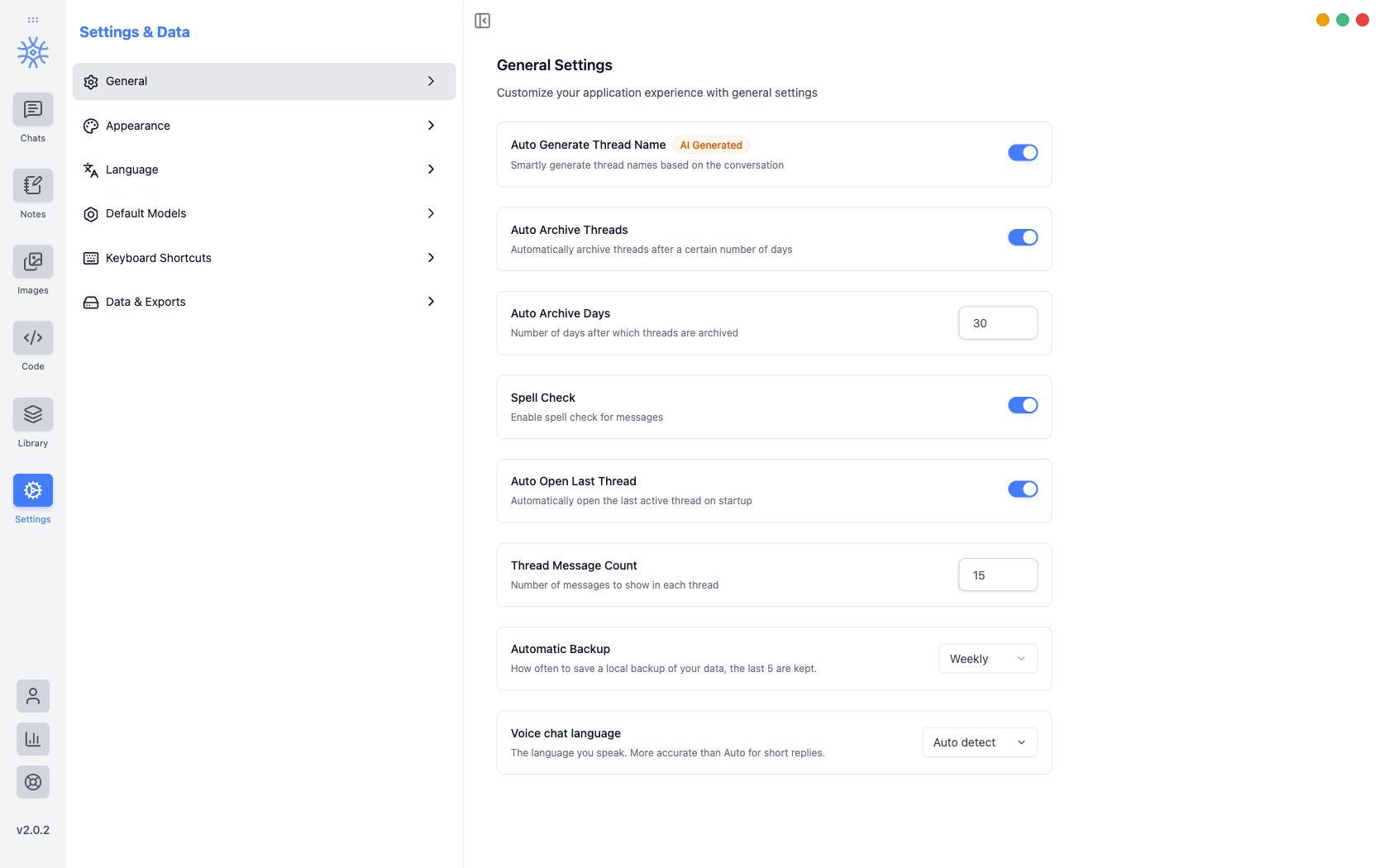
Settings groups everything that changes how the app behaves rather than what a single answer says: appearance and language, the default models new threads start on, keyboard shortcuts, and data exports. Thread housekeeping lives here too — automatic naming, auto-archiving after a set number of days, and how much history a thread shows.
Each section is covered in Settings.
Privacy
Privacy is the reason several of these features exist:
- Local models keep entire conversations on your machine — nothing is sent anywhere.
- Context Shield limits how much of a conversation is sent with your next message. Anchor it at a message and everything before that point is left out of the request, so earlier discussion is not re-sent to the provider.
- Data export lets you back up your whole workspace yourself.
Context Shield controls what leaves your machine from that point in the conversation onward. It has no effect on what a provider does with what it does receive — that is governed by the provider's own policy, so use a local model when data must not leave the device at all.
Privacy and data flow sets out exactly what each feature sends and to whom, including the three that leave your machine even when your chat model is local.
Feature availability can differ between the desktop and mobile builds, and between releases. Check the changelog for what shipped when.