
Tools, Skills, and MCP
What the built-in tools do, how skills shape answers, and how to connect an MCP server safely.
Three things in the Library let the assistant do more than talk, and they work differently enough to be worth separating.
Agentic tools and live web search need Pro. A free account still gets every model, the prompts library, notes, search, and export — see Credits, Pro, and usage.
| What it is | Where it comes from | |
|---|---|---|
| Tool | A function the model can call to do something | 22 built in, or write your own |
| Skill | Instructions that shape how the assistant answers | 3 built in, or write your own |
| MCP server | Someone else's tool collection, connected over the Model Context Protocol | Community list, or add your own |
Tools
Library → Tools lists everything the model can call. The built-in set covers time, the web, and your own workspace:
- Search Web, Read Webpage, Read YouTube Transcript
- Search Knowledge, Search Attachments, Search Conversations
- Manage Memory, Manage Notes, Summarize Thread
- Generate Image, Generate Document, Cite Sources
- Ask User, Get Current Time
Each tool has an Enabled switch, so you can turn off anything you would rather the model never reach for.
What a tool actually does
Open any tool and the whole contract is on screen, which is unusual and worth using.
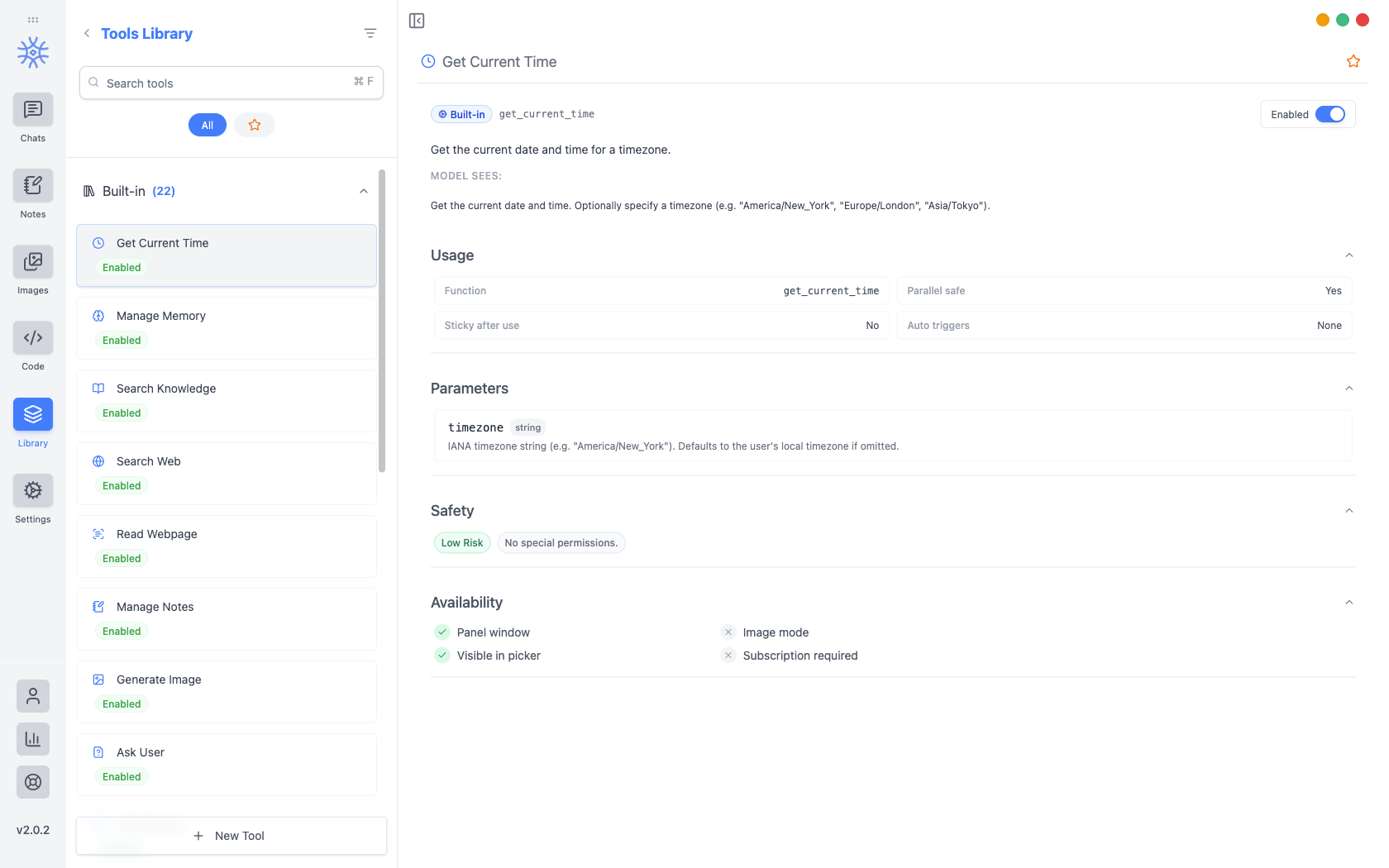
- MODEL SEES is the literal description the model reads when deciding whether to call the tool.
- Usage gives the function name, whether it is safe to run in parallel, whether it stays active after use, and what can trigger it automatically.
- Parameters lists exactly what it accepts.
- Safety carries a risk level and states what permissions it needs — Get Current Time, for instance, is Low Risk with no special permissions.
- Availability shows where it works, including whether it needs a subscription.
Read the Safety line before enabling anything you did not add yourself. It is the quickest answer to "what can this reach".
Use a tool in a chat
Ask for the action directly when you want a specific tool. For example, “What time is it in India right now? Use the Get Current Time tool.” The assistant runs the tool, waits for its result, and then writes the answer from that result.
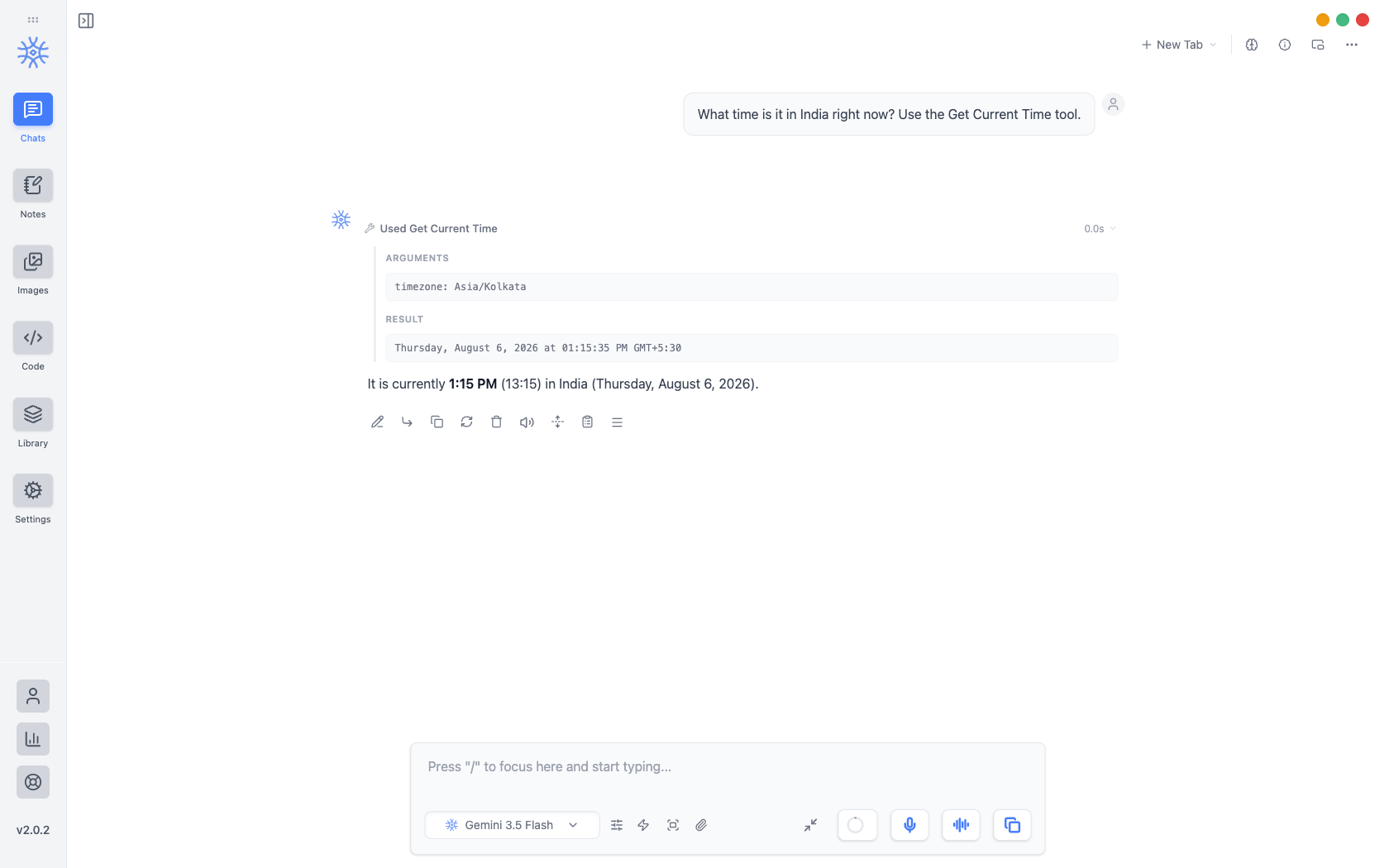
The collapsed row records which tool ran and how long it took. Choose the row to inspect the arguments supplied by the model and the result returned to it. That makes it possible to verify the work instead of relying only on the final sentence.
What a tool sends
Search Web and Read Webpage send a query or a URL out to the internet. Search Knowledge, Search Attachments, and Search Conversations read your local data and put what they find into the conversation, which then goes to whichever model you are using. A local model keeps all of it on your machine; a cloud model does not.
Your own tools
New Tool adds a custom function. It appears in the same list, with the same Enabled switch.
Skills
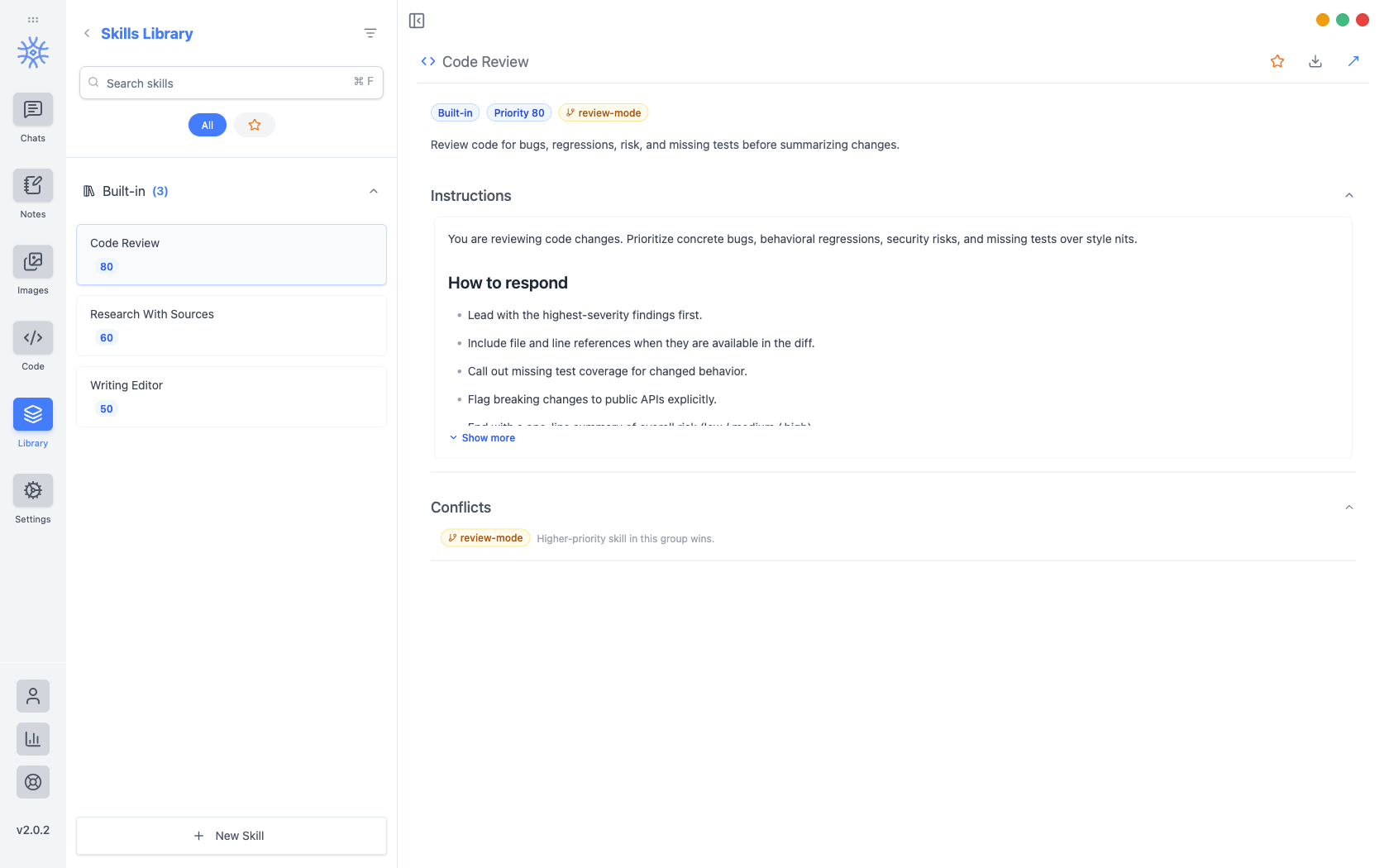
Library → Skills holds instruction sets that change how answers are written rather than what the assistant can do. Each has a priority deciding which wins when more than one applies.
The three built in are Code Review (priority 80), Research With Sources (60), and Writing Editor (50). Open one and you see its instructions and its How to respond rules — Code Review, for instance, leads with the highest-severity findings, cites file and line where the diff provides them, calls out missing test coverage, flags breaking API changes, and closes with an overall risk rating.
Because skills are just instructions, you can read exactly what one does before enabling it, and New Skill lets you write your own.
MCP servers
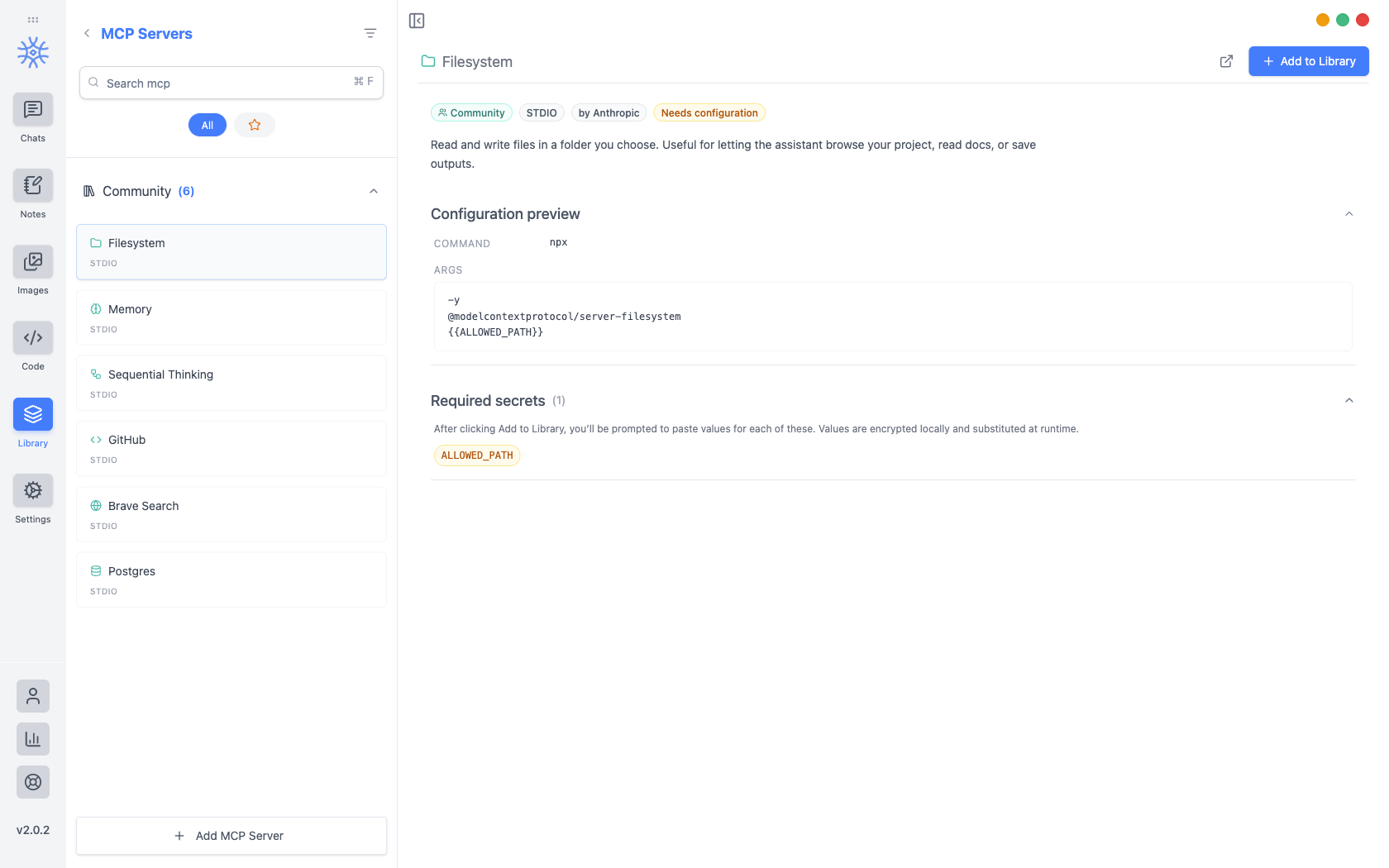
Library → MCP Servers connects external tool collections. The community
list ships with Filesystem, Memory, Sequential Thinking,
GitHub, Brave Search, and Postgres, all run as local STDIO
processes.
Adding one
Each entry shows a Configuration preview before you commit — the command it
will run and the arguments it will receive, so you can see that Filesystem is
npx -y @modelcontextprotocol/server-filesystem pointed at a path you choose.
Servers that need credentials list them under Required secrets and mark themselves Needs configuration. Choosing Add to Library prompts you for each value; they are encrypted locally and substituted in when the server runs, rather than being stored in the configuration itself.
Deciding what to give one
An MCP server is a program running on your machine with whatever access you grant it, so treat adding one like installing software:
- Scope it. Filesystem asks for an allowed path — give it the narrowest folder that does the job, not your home directory.
- Read the command. The configuration preview shows exactly what will run.
- Prefer servers you can identify. The community entries name their publisher.
- Remember the model sees the results. Whatever a server returns enters the conversation, and travels wherever that conversation goes.
Turning things off
Every tool has an Enabled switch, skills can be disabled, and an MCP server can be removed from the Library. If the assistant is doing something you did not expect, that is the first place to look: disable the tool, ask again, and see whether the behaviour goes away.