
The Library
What Agents, Prompts, Models, Tools, Skills, MCP Servers, Attachments, Knowledge, and Memories each do.
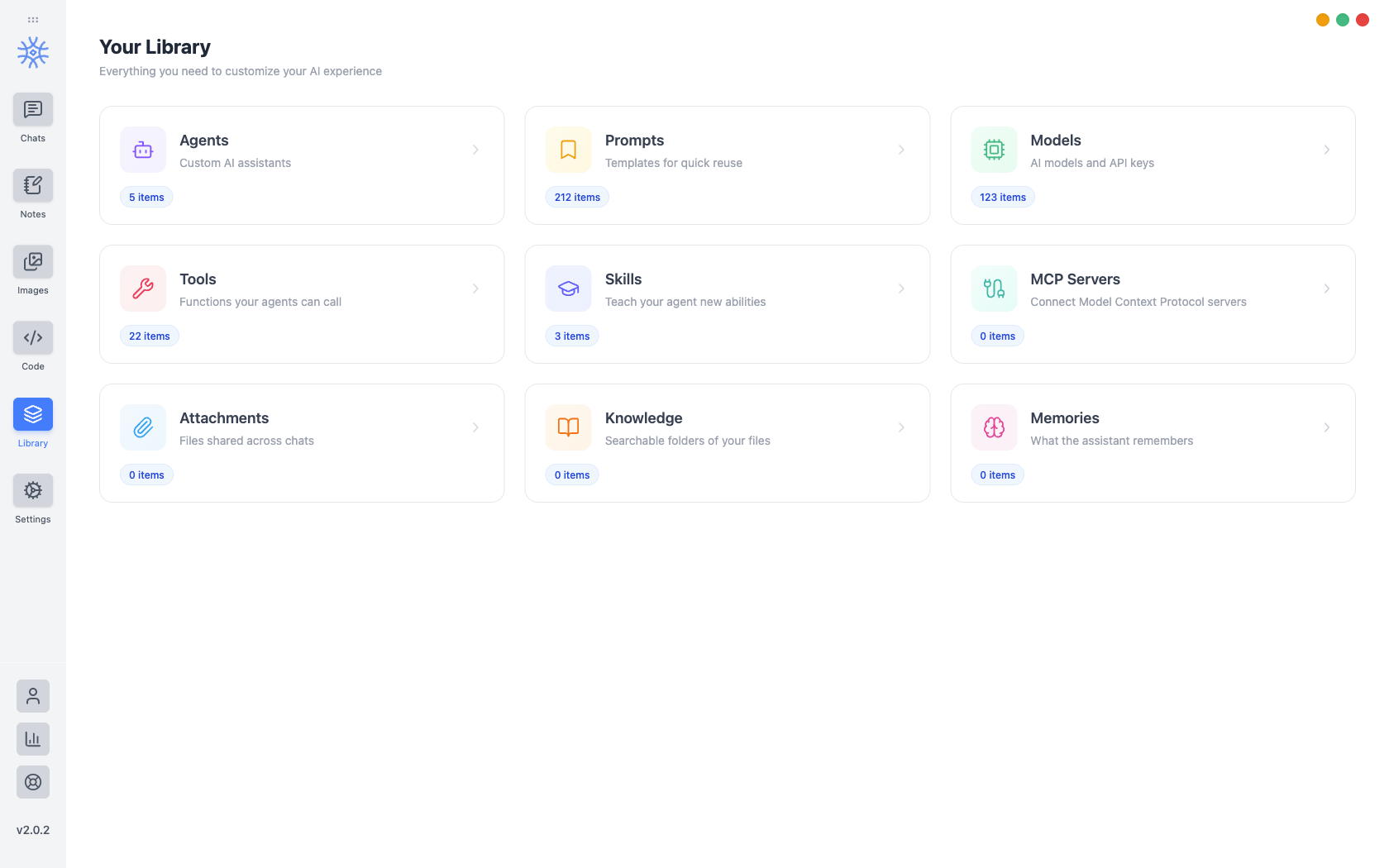
Library is where everything that shapes the assistant lives. Nine sections, each with its own count, and they are easy to confuse — this page is about which one you want.
| Section | What it holds | Ships with |
|---|---|---|
| Agents | Custom assistants — a model, instructions, and the tools it may use | 5 |
| Prompts | Reusable prompt templates | 212 |
| Models | Every model you can pick, and your API keys | 123 |
| Tools | Functions an agent can call to do something | 22 |
| Skills | Abilities you teach an agent | 3 |
| MCP Servers | External Model Context Protocol servers you connect | 0 |
| Attachments | Files you have shared into chats | 0 |
| Knowledge | Folders of your files the assistant can search | 0 |
| Memories | What the assistant has remembered about you | 0 |
The distinctions that matter
Agents vs Prompts. A prompt is text you reuse. An agent is a configured assistant — its own model, its own instructions, and its own set of tools — that you talk to.
Tools vs Skills vs MCP. A tool is a single function the model can call. A skill teaches an agent a capability built from what it already has. An MCP server is someone else's tool collection, connected over the Model Context Protocol, so its tools appear alongside the built-in ones.
Attachments vs Knowledge. An attachment is a file you dropped into one conversation. Knowledge is a folder the assistant can search across conversations, for material you want available repeatedly.
Knowledge vs Memories. Knowledge is what you gave it to read. Memories are what it worked out from talking to you — your projects, your preferences, how you like things written.
Memories
Memories are written to the app's local database on that device. Open Library → Memories to read, edit, or delete any of them.
They do not travel between devices. Handing a conversation to another device pairs the two for that chat; it does not copy your memories.
Models and keys
Library → Models lists the models available to you and holds your API keys. A model can be reached three ways — 9xchat credits, your own key, or a model running locally — and which you choose decides both who bills you and what leaves your machine.
Models and API keys covers adding a provider, browsing catalogues, and what Auto does.